
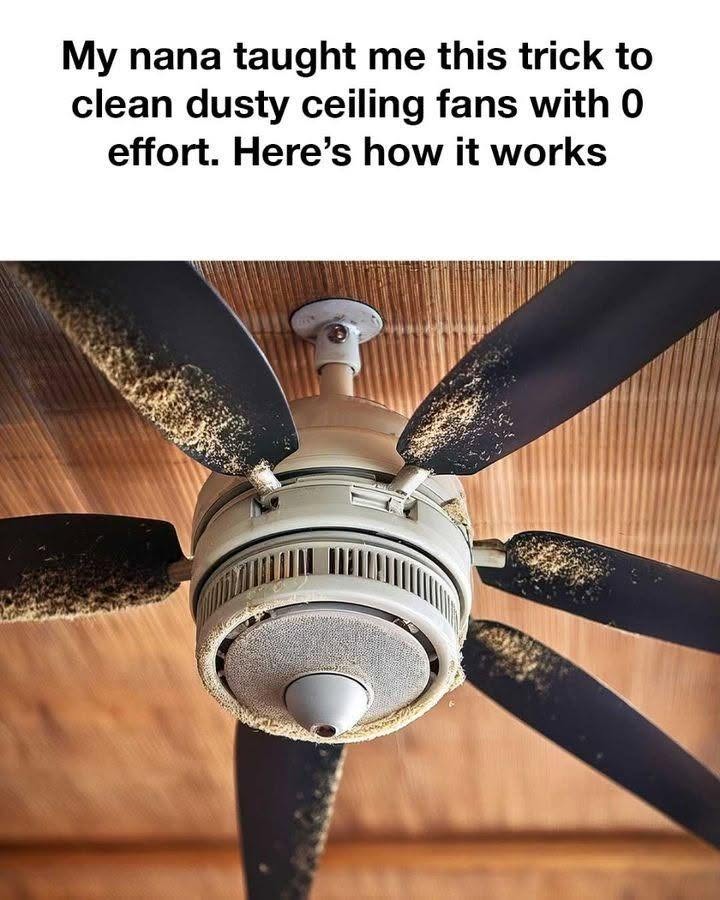
Ask anyone what the most neglected cleaning task in their home is, and ceiling fans come up again and again. They sit up high, out of easy reach, out of sight most of the time — and then one day you look up and realize they’ve accumulated a thick ridge of gray dust on every single blade that you genuinely cannot believe you allowed to build up.
The usual approach involves a stepladder, a damp cloth, and a frustrating ten minutes of watching dust fall off the blades and drift down onto every surface in the room you just cleaned. There’s a better way.
Why Ceiling Fan Dust Is So Stubborn
Ceiling fans accumulate dust more intensely than most other surfaces in the home, and the reason comes down to static electricity and airflow. The spinning blades generate a small static charge that actively attracts and holds dust particles. The airflow they create also draws floating dust toward the blades rather than away from them.
The result is a compressed, packed layer of dust along the top edge and leading face of each blade — dust that doesn’t just wipe off easily but that clings, clumps, and falls in clouds when disturbed.
The conventional approach of wiping with a cloth or feather duster is what sends those clouds of dust raining down on your furniture, floors, and freshly vacuumed carpets. The trick is to contain the dust while you remove it.
The Hack That Changes Everything: A Pillowcase
The genius solution is something already in your linen closet — a standard pillowcase.
Here’s exactly how it works:
Step 1 — Grab an old pillowcase. One you don’t mind getting dusty. Any standard pillowcase works — cotton, polyester, or a blend.
Step 2 — Turn off the fan completely. Wait for the blades to stop moving fully before approaching.
Step 3 — Slide the pillowcase over each blade. Open the pillowcase and slide it fully over one fan blade so the blade is completely inside the pillowcase, like sliding a pillowcase onto a pillow.
Step 4 — Pull it back while pressing gently. Grip the sides of the pillowcase and draw it back along the blade from base to tip while applying light pressure from both sides of the fabric. The pillowcase envelops the blade entirely and captures all the dust inside the case as it’s pulled toward the tip.
Step 5 — Repeat on each blade. Slide the same pillowcase over the next blade and repeat. The dust stays contained inside the pillowcase the entire time — nothing falls to the floor.
Step 6 — Take the pillowcase outside. Once all blades are done, take the pillowcase outside and shake it out, or empty the dust into a trash bag. Then wash the pillowcase as normal.
That’s it. No falling dust. No respiratory irritation from disturbed particles. No re-cleaning everything in the room afterward. The entire job takes under three minutes per fan.
Why This Works So Much Better Than a Duster
A feather duster or dry cloth drags across the top of the blade and displaces the dust — some of it sticks to the duster, but a significant amount falls directly downward. You’re essentially redistributing the dust to your furniture and floor rather than truly removing it from the room.
The pillowcase technique works differently. Because the fabric wraps completely around the blade — top, bottom, and both sides simultaneously — the dust has nowhere to go except inside the pillowcase. The gentle pressure from both sides of the fabric lifts the packed layer of dust cleanly from the blade surface and traps it in the pillowcase.
It’s the same principle as cleaning something with a wrapping motion rather than a wiping motion — complete surface contact means complete dust capture.
How Often Should You Clean Ceiling Fans?
The honest answer is more often than most people do — but far less often than you’d need to if you use this technique regularly.
In rooms with moderate air circulation and regular use, ceiling fans benefit from cleaning every four to six weeks during seasons of regular use. In rooms that get less use, or in homes with pets or known dust sensitivity, every two to three weeks is better.
The advantage of the pillowcase method is that because it’s so fast and easy, the frequency barrier that makes most people put this task off essentially disappears. A task that used to take fifteen minutes of stepladder maneuvering and post-cleaning room re-cleaning now takes three minutes.
Additional Tips for Keeping Ceiling Fans Cleaner Longer
Dust the blades before cleaning the room below. Even using the pillowcase method, do the fan first and the floor and furniture second. Any trace amounts of dust that escape will be picked up in the regular room cleaning that follows.
Run the fan in reverse during winter. Most ceiling fans have a directional switch — a small toggle on the motor housing — that reverses blade rotation. In summer, blades should spin counterclockwise to push air down and create a cooling effect. In winter, reversing to clockwise at low speed pulls cool air up and pushes warm air that has collected near the ceiling down along the walls. This keeps the room warmer with less heating energy. It also tends to reduce dust accumulation slightly by changing the airflow pattern around the blades.
Wipe with a dryer sheet after cleaning. Once the blades are dust-free, run a fresh dryer sheet across the clean surface of each blade. The anti-static coating from the dryer sheet reduces the static charge that attracts dust, meaning it takes longer before significant accumulation occurs again. This simple step can meaningfully extend the time between cleanings.
Clean the motor housing too. The round motor housing at the center of the fan accumulates dust and grease — particularly in kitchens where cooking vapors are present. A damp microfiber cloth works well here. Make sure the fan is off and unplugged or the circuit breaker is off before wiping near the motor housing.
Check and tighten blade screws periodically. While you have the stepladder out for cleaning, take a moment to check that the screws attaching each blade to the blade bracket are secure. Vibration from regular operation can loosen them over time, causing the characteristic wobbling and rattling that makes ceiling fans noisy.
Ladder Safety — Non-Negotiable
Since ceiling fan cleaning requires working at height, a few safety reminders that are too important to skip:
Always use a stable stepladder rated for your weight — never a chair, a stack of books, or an office chair with wheels. Position the ladder on a firm, level surface and ensure all four feet are making solid contact before climbing. Have someone hold the base of the ladder if possible.
Always turn the fan completely off and wait for the blades to stop before approaching. Never attempt to clean a moving fan. Never clean a ceiling fan while standing on furniture.
